
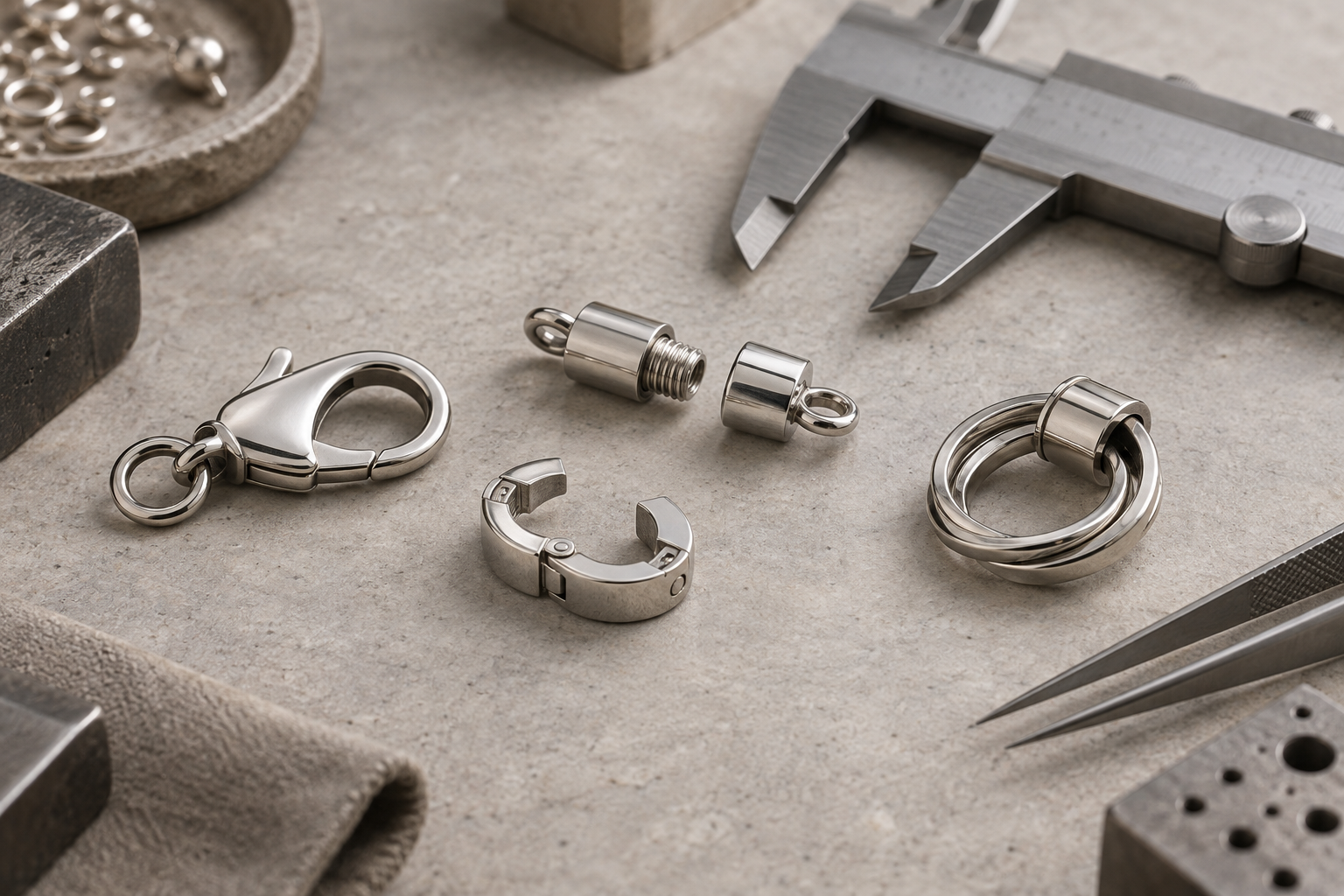
Detachable and Special Jewelry Structure Solutions
Development and Scalable Production of Clasps, Threaded, Openable, and Rotating Structures
Hung Kuang helps jewelry brands develop clasps, threaded components, openable designs, rotating mechanisms, and other detachable or moving structures. From part relationships, load, operating clearance, process sequence, and complete-process sampling to production inspection and repeat orders, we help reduce binding, loosening, misalignment, wear, and functional changes after surface treatment.
1. What Are Detachable and Special Structures in Jewelry?
Detachable and special structures give jewelry functions beyond appearance, such as replacement, opening and closing, rotation, storage, or interaction. Interchangeable pendants, threaded components, openable bracelets, and rotating rings all require multiple parts to work together.
These designs can expand wearing options, collection development, and product recognition. To manufacture them successfully, however, part dimensions, load direction, operating clearance, polishing, plating, and assembly sequence must be considered together.
A special structure is not successful simply because it can move: After every manufacturing step is complete, it must still operate properly, retain a complete appearance, and be reproducible in production.
2. Why Are Special Structures Harder to Reproduce in Production?
| Parts Affect One Another | Downstream Processes Change the Fit and Feel |
|---|---|
|
|
A functional sample does not automatically guarantee stable production: Hung Kuang identifies areas prone to binding, loosening, misalignment, or wear and includes them in structural review and complete-process verification.
3. Confirm the Functional Purpose Before Selecting the Structure
| Design Purpose | What the Brand Wants to Achieve | What Hung Kuang Reviews First |
|---|---|---|
| Detachment and replacement | Replace pendants, parts, or different design components | Removal direction, retention method, load, and operating clearance during replacement |
| Opening and storage | Open a cover, hold an item, or create an inner-and-outer-layer design | Opening angle, closed position, gaps, and wearing safety |
| Rotation and interaction | Add movement, interaction, or adjustable orientation | Contact surfaces, rotational resistance, play, friction, and stopping position |
| Concealed connection | Integrate functional parts without compromising appearance | Internal space, component thickness, assembly sequence, and future servicing |
More complexity does not necessarily mean a better structure: The appropriate solution is selected according to product function, material, dimensions, use conditions, and estimated volume.
4. Four Common Structures and Hung Kuang's Manufacturing Approach
Clasp | PL0118
Fast engagement must also prevent accidental opening or excessive tightness. Hung Kuang verifies the load direction, locking position, and operating feel, then checks the open-and-closed condition on the finished product after all processes are complete.

Threaded Connection | CL1035
Threads can connect detachable parts or functional components. Hung Kuang reviews the insertion direction, engagement length, operating clearance, and stopping position, then confirms assembly before and after surface treatment.

Openable Structure | HL0266
Opening and closing must balance position, gaps, and a complete appearance. Hung Kuang confirms the opening, positioning, and assembly sequence, then inspects the structure again after grinding, polishing, and surface treatment.

Rotating Structure | RL0266#9
In addition to rotation, the design must control resistance, play, noise, and friction. Hung Kuang verifies the contact surfaces, clearance, and rotational resistance, then checks operation and appearance on the complete finished product.

5. How Should a Structure Be Selected? Do Not Ask Only, “Can It Move?”
- Start with how it will be used: Will it be changed occasionally, opened every day, or rotated repeatedly for interaction?
- Review the load direction: Will the product be pulled, twisted, bent, or impacted, or only handled lightly?
- Confirm the material and process: Will forming, polishing, or plating change the contact surfaces?
- Confirm operation and wearability: Is the opening direction intuitive, are the edges smooth, and is there enough room to operate it?
- Define a functional reference: Which sample and inspection method will approve opening, rotation, locking, and appearance?
6. How Does Hung Kuang Manage Process Variation in Special Structures?
- Break down the parts and functions: Confirm the purpose, material, load, and contact position of each component.
- Review the structure and process: Select appropriate forming and machining methods according to dimensions, shape, volume, and function.
- Plan the process sequence: Coordinate forming, grinding, polishing, plating, and assembly so a later step does not compromise function.
- Approve the product after the complete process: Inspect the final appearance, clearance, and operating feel—not only the unfinished component.
- Turn risk areas into checkpoints: Establish inspection priorities for locks, threads, shafts, contact surfaces, and moving areas.
- Retain the approved reference: Use the approved finished product and records to support production and future repeat orders.
Hung Kuang's value is not limited to making individual parts: We review the structure, manufacturing process, surface treatment, assembly, and final operation within one production plan.
7. Complete-Process Verification and Component Breakdown
Post-Process Verification × Component Breakdown and Assembly
Grinding, polishing, and plating may change contact surfaces and clearances, so function and appearance must be verified again after surface treatment. Special structures also require a clear understanding of parts, contact surfaces, and assembly directions to plan the process and identify interference, binding, or assembly problems early.

8. Development and Production Workflow with Hung Kuang
9. What Should a Brand Prepare Before Requesting a Quote?
- Product information: Product photos, 2D or 3D drawings, an existing sample, or a reference structure.
- Functional purpose: Whether the design should detach, open, rotate, store an item, or solve an existing problem.
- Materials and finishes: Materials, colors, gloss levels, and surface-treatment requirements for each area.
- Use conditions: Operating frequency, wearing conditions, load direction, and non-negotiable details.
- Production conditions: Number of styles, estimated quantities, launch schedule, and repeat-order plan.
- Current problems: Binding, loosening, wear, noise, scratching, or incomplete appearance.
Let Hung Kuang Help You Break Down the Manufacturing Challenges in a Special Structure
Please provide: Drawings or samples, materials, functional requirements, surface finishes, estimated quantities, and the problems currently encountered.
Hung Kuang will help: Review part relationships, structure and process, process sequence, complete-process sampling, and production inspection to identify a feasible direction step by step.
↗ Contact Hung Kuang for a Special-Structure Product Evaluation