
Jewelry Laser Cutting Solutions
Flat Jewelry Development, Scalable Production, and Reliable Reordering
For flat metal jewelry such as name necklaces, logo tags, openwork pendants, and geometric components, Hung Kuang evaluates laser cutting according to material, thickness, structure, and reorder volume. We integrate sampling, edge finishing, surface treatment, and production management to help established brands reduce revision costs while maintaining collection quality and repeat-order consistency.
1. What Is Laser Cutting, and How Is It Different from CNC?
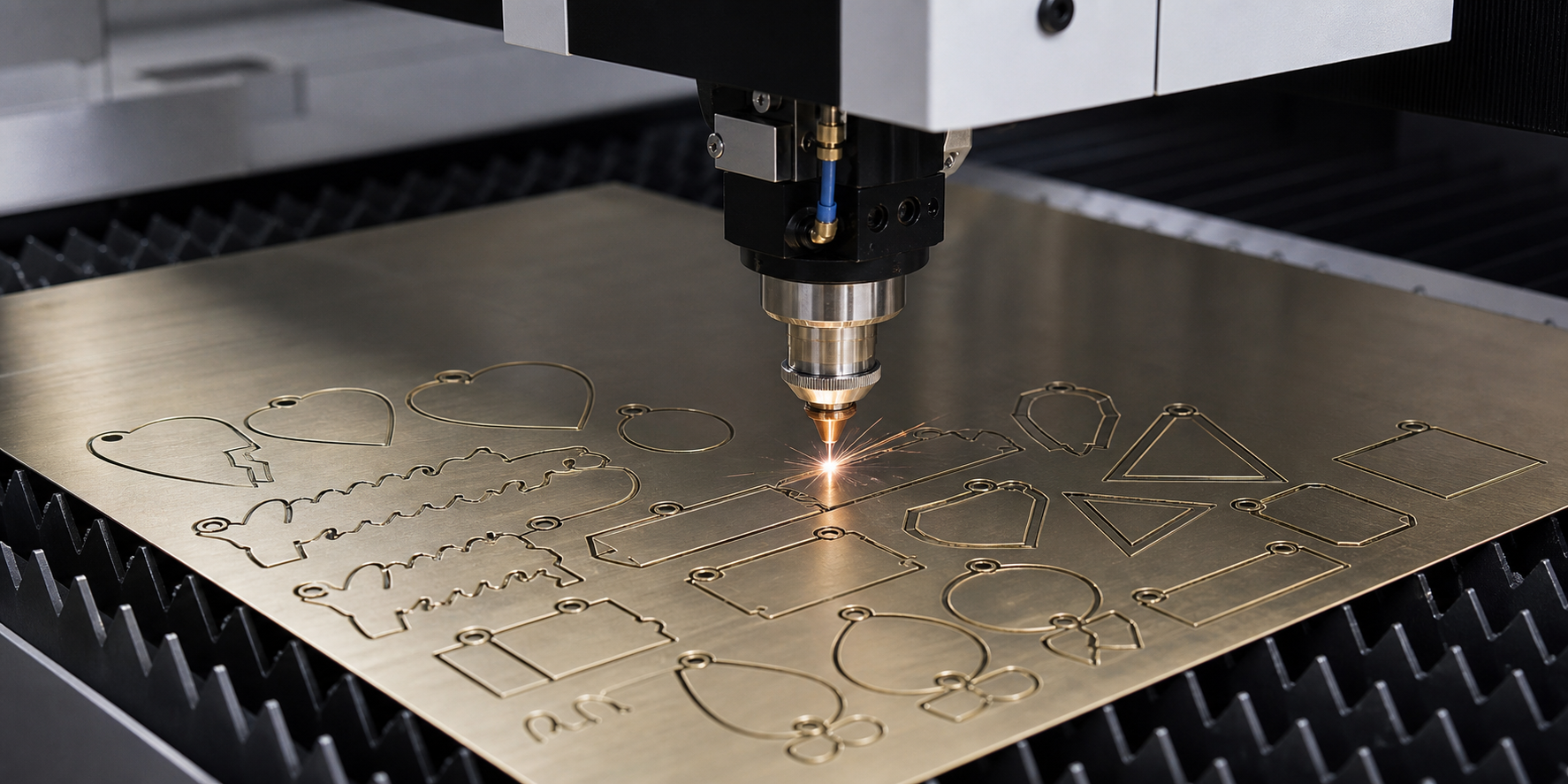
Laser cutting does not use a physical blade, drill, or rotating tool to contact the material. Instead, a focused laser beam follows the digital file path to cut through flat metal sheet, creating outer profiles, holes, or openwork patterns. Laser engraving or marking adds text, textures, or identification to the surface and usually does not cut through the material.
Flat designs: evaluate laser cutting first. Nameplates, letters, logo tags, geometric sheet components, and openwork patterns are suitable for laser cutting when the primary profile remains on one plane and can be produced from a 2D file.
Three-dimensional designs: evaluate CNC first. Thick components, curved surfaces, raised or recessed forms, and structures that must be machined from solid material are generally better suited to CNC. Complex three-dimensional jewelry may also be evaluated for casting.
2. Suitable Jewelry Applications
Hung Kuang laser-cut product illustration: flat 2D designs cut from metal sheet, including names, letters, logo tags, openwork pendants, and geometric components.

3. How Should Brands Choose Between Laser Cutting, Stamping, CNC, and Casting?
| Process | Best-Suited Conditions | Key Considerations for Established Brands |
|---|---|---|
| Laser Cutting | Flat sheet, lettering, openwork, and multiple design variations | Minimum line strength, heat effects, and edge finishing |
| Stamping | Flat or shallow-formed components, fixed designs, higher volumes, and repeated long-term production | Tooling investment, revision cost, forecast volume, and die management |
| CNC | Thick components, three-dimensional machining, curved surfaces, and structures requiring controlled dimensions | The main considerations are forecast quantity and cost efficiency; structural dimensions and tolerances are strengths that CNC is designed to manage |
| Casting | Three-dimensional forms, curved surfaces, relief details, or jewelry with substantial volume | Tooling, shrinkage, post-casting finishing, and batch quality |
4. Production Nesting and Reliable Reordering
Hung Kuang laser-cutting production nesting illustration: repeated flat tag profiles arranged on one metal sheet to explain production layout and repeat-order planning.

5. How Hung Kuang Evaluates a Laser-Cutting Project
- File and structure review: Check the drawing, openwork, hole positions, and load directions for production feasibility.
- Material and finishing alignment: Confirm material, thickness, appearance, and downstream finishing requirements.
- Sample approval: Control the approved sample, file version, and key specifications.
- Production integration: Coordinate deburring, polishing, assembly, and inspection.
6. Production and Reordering Require More Than Cutting
Managing multiple styles requires clear file naming, sample approval, sheet nesting, and production scheduling. Material, thickness, openwork density, surface effect, component assembly, and reorder volume all affect cost and consistency. Actual minimum order quantities, sampling schedules, and production lead times must be confirmed according to the design and process combination.
7. Frequently Asked Questions
If a line can be cut, is it automatically suitable for production?
Not necessarily. Cuttable does not mean suitable for production or wear. Minimum line width, unsupported areas, connection points, material, thickness, finished size, load direction, and polishing allowance must be evaluated together.
Is laser cutting always less expensive than stamping for small multi-style orders?
Not necessarily. If a design is fixed and expected to be reordered in higher volumes over a long product life cycle, stamping may be more economical.
Can plating color be guaranteed never to fade?
No responsible manufacturer should make that blanket guarantee. Plating performance depends on the base material, pretreatment, plating system, use conditions, and care. Required testing or market standards should be confirmed before development.
Let Hung Kuang Evaluate the Right Process and Production Plan
Please provide your drawing or product photo, material and dimensions, style count and estimated quantity, reorder frequency, target surface effect, components, target market, and expected schedule. Hung Kuang will first determine whether laser cutting is appropriate, then compare stamping, CNC, casting, or a hybrid process where needed.