
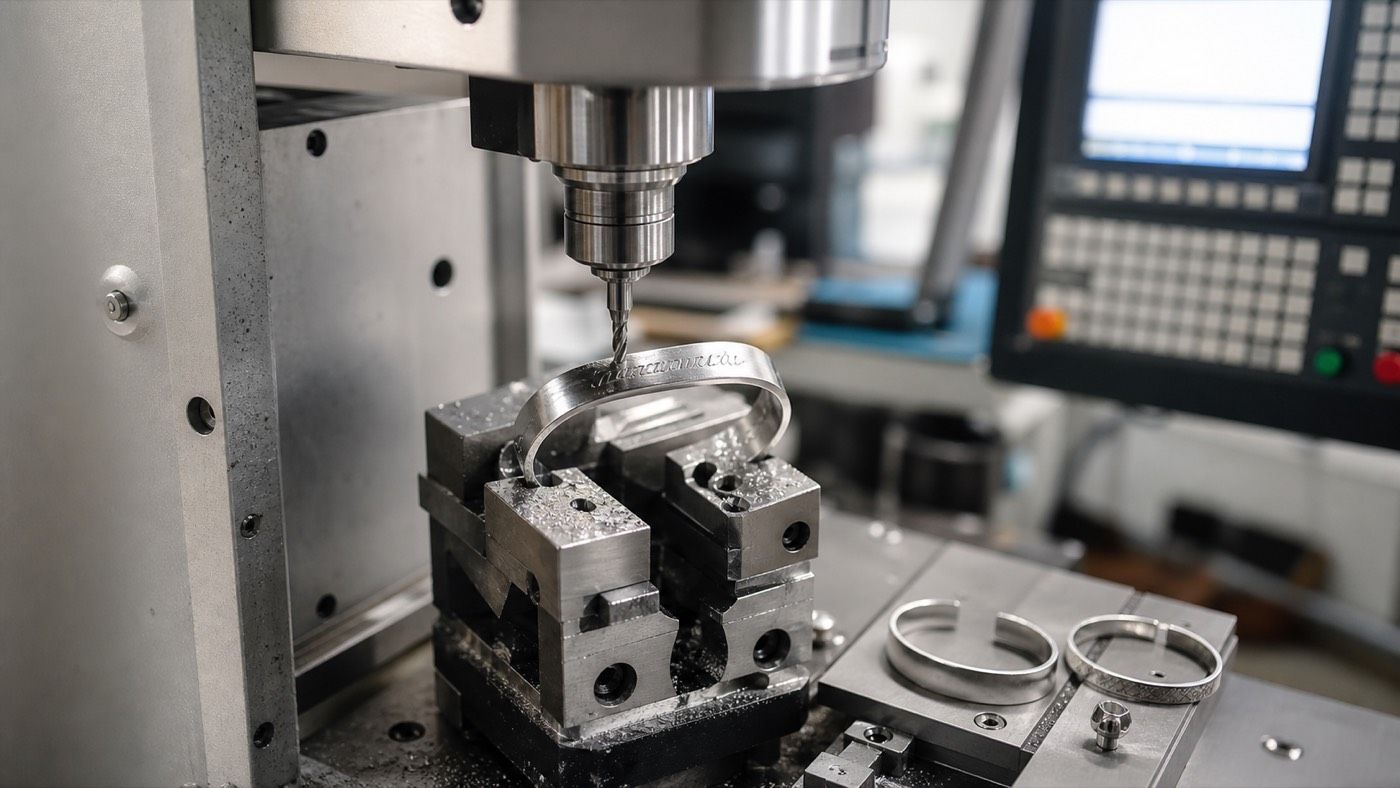
High-Precision CNC Machining Solutions
Precision Jewelry Components and CNC Name Bracelet Manufacturing
HUNGKUANG provides jewelry-grade CNC precision machining for established jewelry and accessory brands developing name bracelets, open cuff bracelets, geometric rings, dimensional logo parts, and precision structural components. From process evaluation and 3D modeling to sampling, mass production, finishing, and repeat orders, we help brands balance structural strength, dimensional consistency, fine-detail quality, and reliable replenishment.
1. Why Established Jewelry Brands Need to Select the Right Process First
For established jewelry and accessory brands with ongoing sales, the first development question is rarely just, “Can this design be made?” More important questions include: Which manufacturing process will best preserve the design details? Will the dimensions and structural performance remain consistent in mass production? Is the product suitable for repeat orders? Can cost, lead time, and quality be controlled over time?
CNC precision machining, casting, laser cutting, wire EDM, and finishing each suit different design conditions. Selecting the wrong process at the beginning may increase development costs, weaken the structure, reduce the consistency of fine details, or create avoidable variation during mass production.
2. What Is CNC in Jewelry Manufacturing?
CNC stands for Computer Numerical Control. In jewelry and accessory manufacturing, computer-controlled toolpaths are used to cut, engrave, or refine metal so that dimensions, angles, thicknesses, and structural details can be produced with repeatable accuracy.
Unlike casting, CNC is a subtractive manufacturing process. It begins with metal stock or a semi-finished component and precisely removes material until only the intended form and structure remain. CNC is especially useful for jewelry that requires controlled angles, defined thicknesses, crisp edges, or functional structures—but it is not the best process for every design.
3. CNC Name Bracelets: A Scalable Collection, Not One-Off Personalization
HUNGKUANG helps established brands evaluate letter thickness, bracelet curvature, fit and wearability, edge finishing, and finishing stability for CNC name bracelets. These products are better planned as scalable collections with repeat orders and controlled production consistency rather than as one-off personalized pieces.

Product types that are often suitable for CNC evaluation include:
- Stainless-steel open cuff bracelets, bracelets made from hard metals, and components requiring reliable opening or closing mechanisms
- Name bracelets requiring controlled thickness, clean edges, and repeatable dimensions
- Geometric rings, dimensional logo parts, brand metal tags, and precision-machined components
- Repeat-order collections that require consistent dimensions, angles, hole positions, or edge profiles
Sterling silver or brass components—including clasps, locking parts, or spring-loaded mechanisms—do not automatically require CNC machining. HUNGKUANG evaluates the component structure, target cost, and production volume to determine whether casting combined with clasps or springs, or another hybrid process, would provide a better balance of quality and cost.
4. Which Jewelry Products Are Suitable for CNC?
CNC is often evaluated for stainless-steel open cuff bracelets, bracelets made from hard metals, fixed-thickness name bracelets, geometric rings, dimensional logo parts, brand metal tags, and precision structural components requiring stable dimensions. Sterling silver or brass clasps do not always require CNC; HUNGKUANG evaluates casting, clasp, spring-loaded, or hybrid processes according to the structure, budget, and production conditions.

5. CNC Production Workflow: From Design Review to Repeatable Production
The steps below are presented as real text so buyers and search engines can clearly understand how HUNGKUANG supports a project from design evaluation through stable production. The icons serve only as visual guides.

1. Design and Structural Review
Confirm drawings, 3D files, material, thickness, dimensions, fit and wearability, and finishing requirements.

2. Toolpath and Fixture Setup
Define CNC toolpaths, holding methods, fixture requirements, and machining sequence according to the product conditions.

3. Precision Machining
Produce the main form, angles, holes, edges, and structural details while verifying dimensional and structural stability.

4. Finishing and Quality Inspection
Integrate polishing, plating, coloring, assembly, and quality checks to reduce variation between samples and mass production.
6. CNC, Casting, or Laser Cutting: How Should a Brand Choose?
| Process | Suitable Products | Advantages | Key Considerations |
|---|---|---|---|
| CNC Precision Machining | Stainless-steel open cuff bracelets, name bracelets, geometric rings, dimensional logos, precision structural components | Stable dimensions, crisp lines, controlled structures, and strong repeatability for ongoing orders | Higher setup and machining costs; generally unsuitable for one-off or extremely low-volume personalization |
| Casting | Floral, animal, cultural, sculptural, curved, and complex three-dimensional designs | High design freedom and efficient production for curved or dimensional pieces at suitable volumes | Shrinkage, porosity, polishing allowances, and detail finishing must be controlled |
| Laser Cutting / Wire EDM | Flat nameplates, name necklaces, thin logo parts, and outline-cut components | Fast design changes, no dedicated mold, and good flexibility for flat profiles | Stroke width, edge strength, material thickness, and post-processing require careful control |
7. How HUNGKUANG Evaluates Whether CNC Is the Right Process
HUNGKUANG does more than accept a production order. We first evaluate which process best suits the product. Key considerations include:
- Material characteristics: Stainless steel, sterling silver, brass, and other metals require different machining and forming approaches.
- Product structure: Whether the design requires opening and closing, load-bearing strength, defined thickness, controlled hole positions, or precise angles.
- Design details: Whether the linework, edges, letter thickness, and surface effect are suitable for CNC.
- Production volume: Sampling, collection testing, mass production, and recurring replenishment have different cost structures.
- Budget and lead time: The selected process should balance quality, cost, delivery, and repeat-order consistency.
Let HUNGKUANG Evaluate the Right Process for Your Collection
If your brand is developing CNC name bracelets, open cuff bracelets, geometric rings, dimensional logo parts, precision clasps, or jewelry collections requiring reliable replenishment, please provide:
- Design drawings or 3D files
- Product photos or reference samples
- Estimated quantity and reorder frequency
- Target material and finishing requirements
- Planned launch or replenishment date
HUNGKUANG will evaluate whether CNC, casting, laser cutting, wire EDM, or a hybrid process is the best fit, then recommend suitable sampling, production, finishing, and repeat-order requirements.