
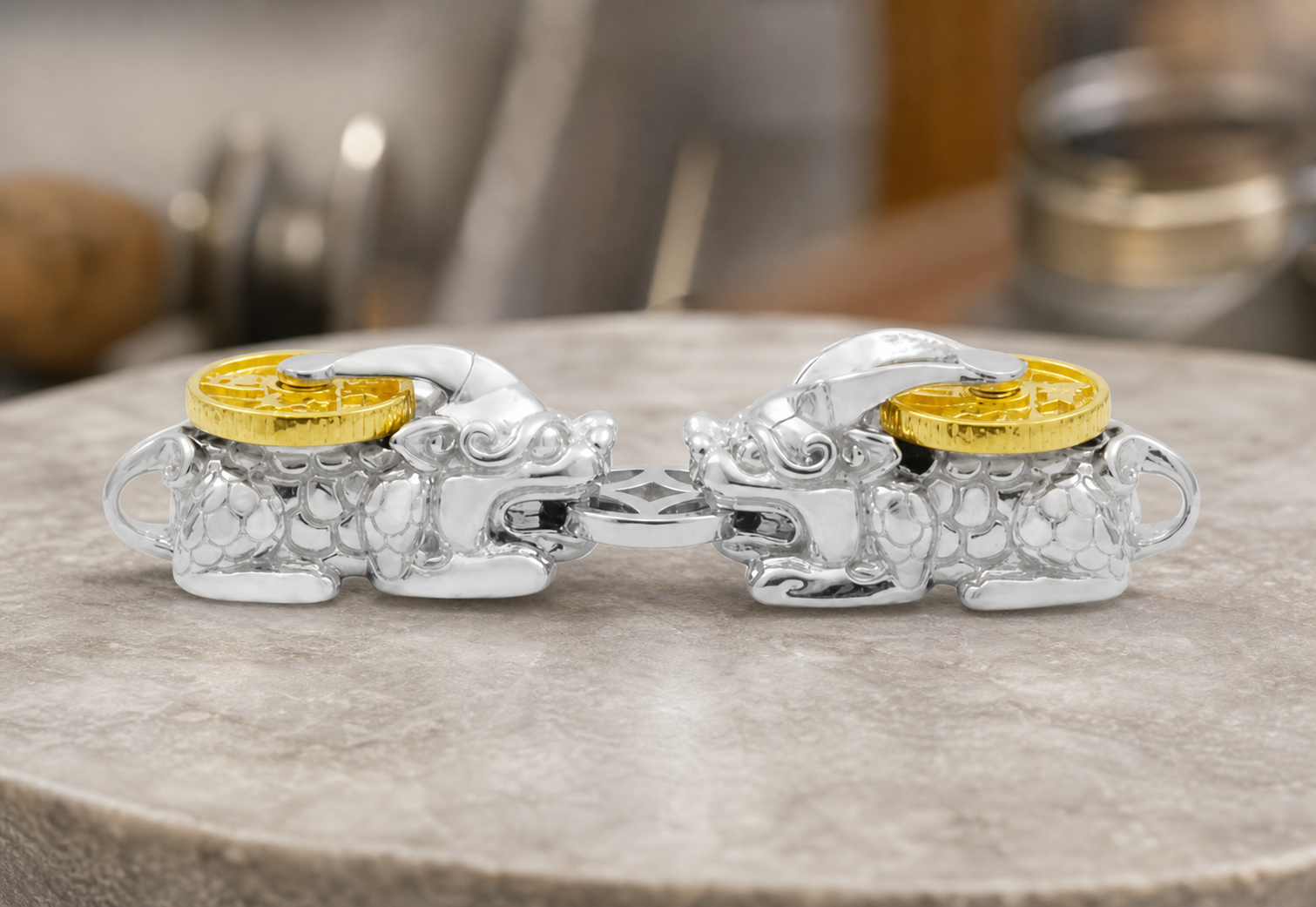
Mixed-Material Jewelry Integration Solutions
Material Selection, Joining Structure, and Scalable Production Control
Hung Kuang helps jewelry brands evaluate mixed-material designs combining two metals or metal with gemstones, pearls, enamel-colored components, or natural-stone bead components. From material selection, joining structure, process sequencing, and sample approval to production QC, we help reduce loose or detached components, misalignment at material junctions, cosmetic inconsistencies, and variation in repeat orders.
1. What Is Mixed-Material Jewelry Integration?
Mixed-material jewelry integration means using two or more materials with different properties in one product. Hung Kuang's current capabilities include designs that combine two metals for different functions, as well as metal with gemstones, pearls, enamel-colored components, or natural-stone bead components.
Mixed-material designs may also combine different plating colors: In CL0892-2, components made from different materials work together with silver- and gold-tone finishes to create visual depth. The product must therefore be reviewed as a complete assembly, including plating sequence, color coordination, component connection, and overall integrity.
For brands, mixed materials can add color, tactile contrast, natural texture, or structural function. For manufacturing, they require coordinated control of dimensions, load, surfaces, heat tolerance, cleaning, and processing limitations across different materials.
2. Why Is Mixed-Material Jewelry Harder to Produce Consistently?
| Different Materials Behave Differently | One Successful Sample Does Not Guarantee Stable Production |
|---|---|
|
|
The key question for a brand is not only whether a sample can be made: It is whether the joining quality and appearance can be reproduced after the complete process, in mass production, and in future repeat orders.
3. Confirm the Design Purpose Before Selecting Materials and Structures
| Design Purpose | Result the Brand Wants | What Hung Kuang Reviews First |
|---|---|---|
| Visual Differentiation | A complete product with clear material layers and natural-looking junctions and finishes | Overall completeness, mixed-material junctions, surface finish, and process sequence |
| Structure or Function | Selected areas that better withstand bending or pulling, or allow movement | Load direction, fixing method, dimensions, tolerances, movement clearance, and use conditions |
| Weight and Wearability | Lower weight, adjusted tactile feel, or better wearing balance | Component weight, center of gravity, thickness, edges, and skin-contact positions |
| Cost and Supply | Retain quality in priority areas while adjusting materials elsewhere | Minimum purchase quantities, substitute materials, processing cost, and availability for repeat orders |
Material selection is not based on unit price alone: If a lower-priced material adds joining, finishing, inspection, or defect risk, the total product cost may not be lower.
4. Common Mixed-Material Combinations and Manufacturing Priorities
| Combination | Common Applications | Main Manufacturing Priorities |
|---|---|---|
| Different Component Materials × Different Plating Colors | Main bodies combined with clasps, moving parts, or decorative components made from other materials, presented in two-tone or multi-tone finishes | Joining compatibility, the plating method for each material, plating sequence, color boundaries, and component junctions |
| Metal × Gemstone or Pearl | Setting, wrapping, threading, or suspended designs | Material fragility, dimensional and appearance ranges, setting structure, friction, and downstream processes |
| Metal × Enamel or Colored Components | Brand colors, patterns, or localized color effects | Recesses and boundaries, adhesion, surface evenness, and process sequence |
| Metal × Natural-Stone Beads or Beaded Components | Bracelets, beaded accessories, pendants, and connector structures | Bead diameter, hole diameter, tolerances, arrangement, metal-component fixation, and movement clearance |
How Are Different Materials Joined? Three Product Structures Require Different Priorities
9BW0117 | Cord, Chain Components, and a Dangling Bead
Handwoven cord is combined with metal chain components and a single dangling bead. Connecting rings and chain links integrate the different materials into one bracelet. Development should consider cord finishing, metal connections, and bead movement as one complete structure.

9BW0085 | Cord, Sterling Silver Frame, and Bead
Handwoven waxed cord passes through a sterling silver frame with a blue sandstone bead at the center. The priority is to create a balanced, complete composition among the cord, metal structure, and bead.

Z21860HZC | Metal Form and Freshwater Pearl
A gold-tone sterling silver curve wraps around a freshwater pearl so the metal form and pearl create the product silhouette together. Development should coordinate pearl size, metal curvature, and pair-to-pair appearance.

5. How Should the Joining Method Be Selected? Do Not Ask Only, “Can It Be Glued?”
Mixed materials may be joined by setting, wrapping, threading, riveting, snap-fitting, threading with screws, soldering, adhesive bonding, or a combination of methods. No single method suits every product, and a sample that remains secure temporarily does not prove that mass production and long-term use will be trouble-free.
- Review the load first: Will the product be pulled, twisted, bent, or rubbed, or is the component decorative only?
- Then review the materials: Can each material tolerate heating, cleaning, acid treatment, polishing, plating, or curing conditions?
- Confirm the process sequence: Which components must be finished first, and which materials must be assembled last?
- Confirm repair and replacement needs: Does the product need to be disassembled, replaced, or serviced after sale?
- Define acceptance criteria: How will joining strength, junction appearance, movement, and material variation be evaluated?
6. How Hung Kuang Manages Process Differences in Mixed-Material Designs
- Identify the material of every component: Confirm each part's material, purpose, required specifications, and acceptable substitute range.
- Review structure and process first: Select an appropriate joining or combination method based on load, appearance, dimensions, and downstream processes.
- Plan the correct process sequence: Coordinate casting, CNC, stamping, laser cutting, polishing, plating, coloring, and assembly so a later process does not damage an earlier result.
- Approve a sample made through the complete process: Review the full assembly, surface finish, junctions, and use condition—not only an individual component.
- Turn risk areas into QC checkpoints: Establish inspection criteria for joints, gaps, excess adhesive, scratches, color differences, natural pattern variation, and moving structures.
- Retain samples and versions: Reassess the impact when materials, structures, or supply conditions change so repeat-order batches do not lose their reference standard.
Hung Kuang's value is not simply the ability to assemble components: We evaluate metal forming, surface treatment, purchased or non-metal materials, assembly, and acceptance criteria within one manufacturing plan.
7. Pixiu Mixed-Material Cases: Bead Support and Gemstone Positioning
CL1081 | Metal Frame Supporting a Bead
A double-pixiu metal structure supports a gemstone bead at the center and allows different beads to be exchanged. Review priorities include bead size, hole position, frame clearance, ease of replacement, stability after insertion, and overall appearance.

HL0160-1 | Gemstone Positioning within the Metal Form
Deep-red gemstone components are positioned within a double-pixiu metal form so the color and metal outline work together. Review priorities include gemstone size, fixing position, left-right arrangement, metal contact areas, connection points, and overall completeness.

The joining logic may differ even when both products combine metal and gemstones: CL1081 focuses on how the bead is supported by the metal frame and replaced; HL0160-1 focuses on gemstone positioning within the metal form and left-right consistency.
8. Development and Production Workflow with Hung Kuang
9. What Should a Brand Prepare Before Requesting a Quote?
- Product information: Product photos, 2D or 3D drawings, a current sample, or an approved sample.
- Material by component: Each part's material, required specifications, and acceptable substitute range.
- Design purpose: Whether the priority is appearance, structure, weight, wearability, or cost.
- Structure and surface finish: Joining positions, movement, color, gloss, texture, and non-negotiable details.
- Production conditions: Number of styles, first-order quantity, reorder frequency, annual demand, and expected schedule.
- Quality conditions: Target market, use conditions, specified tests, acceptance criteria, and current quality issues.
Let Hung Kuang Help You Identify the Manufacturing Risks in Your Mixed-Material Design
Please provide: Drawings or samples, materials for each component, joining positions, surface finishes, estimated quantities, repeat-order requirements, and current issues.
Hung Kuang will help: Review material selection, joining structure, process sequence, complete-process sampling, and production QC to determine whether the design can be manufactured consistently.