
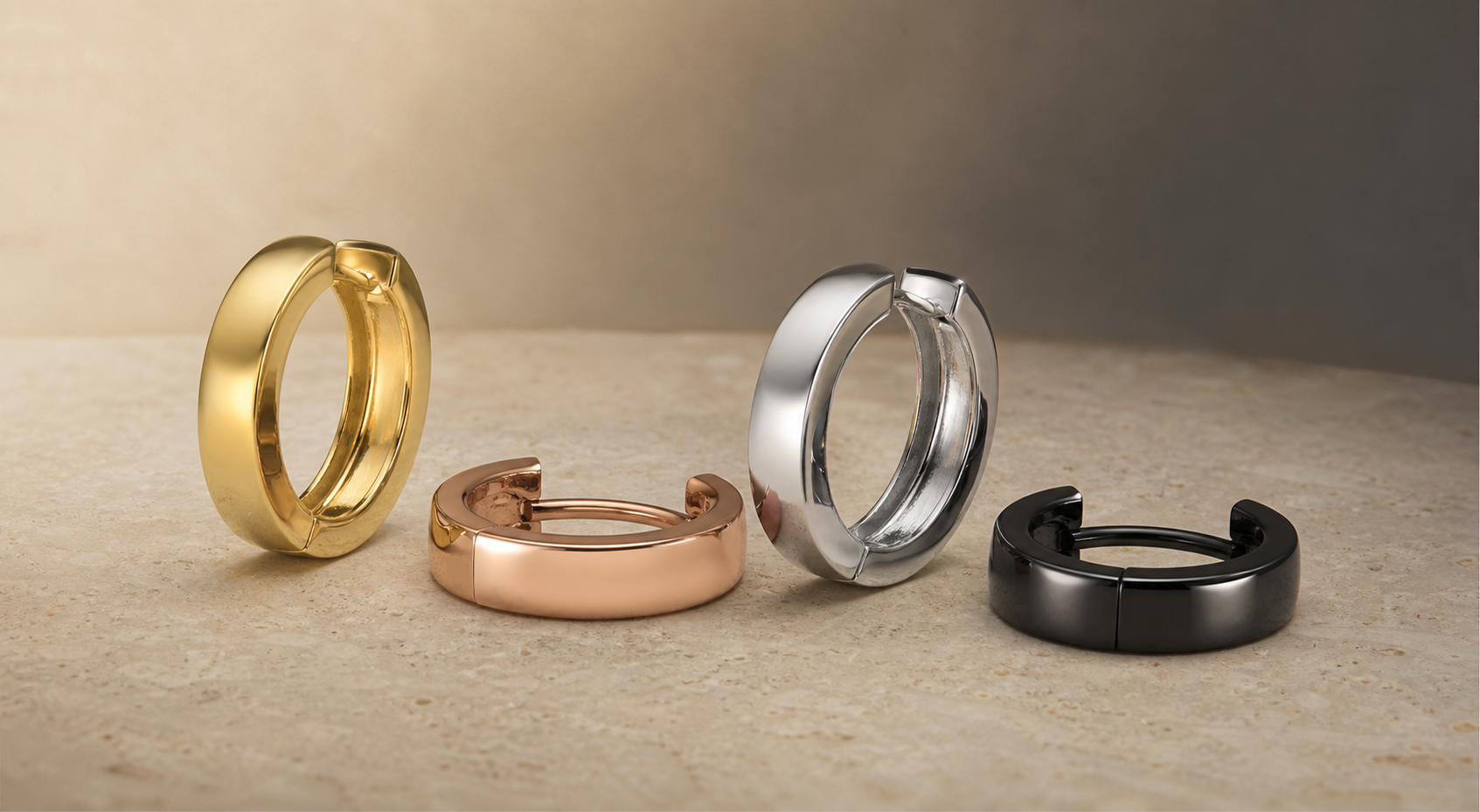
Jewelry Plating and Surface Treatment Solutions
High-Quality Jewelry Plating, Surface Detail, and Wear Performance
Hung Kuang uses high-quality, nickel- and chromium-free jewelry plating. From grinding, polishing, acid cleaning, and material-specific base and color layers to final protection and inspection, we manage surface appearance, wear performance, and product cost as one complete process. This page explains the difference between high-quality plating and simplified low-cost processes, the material applications of wet plating and IP vacuum plating, and the information brands should prepare before requesting a quotation.
1. What Is Jewelry Plating, and Why Does It Affect Overall Quality?
Jewelry plating forms a specified color and protective finish on the surface of metal jewelry, creating gold, rose gold, silver-white, or black appearances. Each base material has a well-established plating system: sterling silver uses a base-layer system suited to silver, while brass alloys use a corresponding system. The layers are not arbitrarily recombined for every project.
Hung Kuang uses high-quality jewelry-grade plating that contains no nickel or chromium. We do not treat plating as a final coloring step. Instead, we manage the entire sequence—from upstream forming, grinding, polishing, acid cleaning, and material-specific base and primary color layers to final protection and inspection.
Plating cannot conceal every upstream defect. Casting porosity, machining marks, solder joints, uneven polishing, residual oil, or surface scratches may become more visible after plating. Jewelry plating quality therefore begins with product forming and surface preparation, not only when a part enters the plating bath.
Why does jewelry plating still fade?
Hung Kuang uses nickel- and chromium-free jewelry-grade plating suitable for jewelry worn against the skin, but it should not be described as permanently fade-proof. Industrial hardware such as faucets uses different plating materials and durability targets, and some industrial systems include nickel. These are not the same specifications used for skin-contact jewelry and should not be compared directly in terms of cost or service life.
2. Where Do Quality Differences in Jewelry Plating Usually Appear?
Plating itself also varies in quality. Looking only at the front of a sample or its color immediately after production does not reveal the whole picture. What brands should compare is whether the process is complete, whether details are properly managed, and whether both parties have clear approval standards.
Lower-cost approaches often reduce cost not by removing a color, but by omitting intermediate processing details such as pre-plating grinding and polishing, acid cleaning, base-layer transition, coverage in detailed areas, or final protection. These differences may not be obvious immediately after production, but they affect surface refinement, coating stability, and wear performance. Hung Kuang uses high-quality jewelry plating and focuses on completing every preparation, plating, and protection step.
| Quality Factor | Hung Kuang's High-Quality Jewelry Plating | Possible Differences in Lower-Cost Simplified Processes |
|---|---|---|
| Pre-Plating Surface | Grinding, polishing, and buffing are completed first to level the surface before acid cleaning. | If complete surface preparation is omitted, upstream defects may become more visible after plating. |
| Acid Cleaning | Acid cleaning is performed after surface preparation so the base layer can be built under suitable surface conditions. | Insufficient pre-plating cleaning or acid treatment may affect coating uniformity and adhesion performance. |
| Base and Primary Color Layers | Established material-specific plating methods are used for sterling silver, brass alloys, stainless steel, and other base materials. The primary color layer is applied after the base layer. | If the base material and corresponding process are not confirmed first, the target color alone cannot determine overall quality. |
| Final Protection | After the primary color layer, a protective top layer or e-coating is added to improve performance in everyday use. | Increasing thickness alone, while overlooking final protection and earlier preparation, may still limit durability. |
| Details and Color | Edges, recessed areas, holes, solder joints, hanging points, and high-friction areas are managed, with approved samples, gloss standards, and retained samples used for production comparison. | If only the front color is approved, detailed coverage and batch evaluation may lack a shared standard. |
What to compare: When requesting quotations, brands should compare the actual process, specifications, and acceptance criteria—not only the immediate color and unit price.
3. What Additional Details Does Hung Kuang Manage in Its Plating Process?

Hung Kuang manages jewelry plating quality in the following sequence:
- Confirm the base material and upstream process: Identify sterling silver, brass alloy, stainless steel, or other materials, and review surface conditions left by casting, CNC machining, soldering, and assembly.
- Level the surface before plating: Use grinding, polishing, and buffing as required to remove machining marks, solder points, and uneven areas so defects are not magnified after plating.
- Complete acid cleaning: After surface preparation, perform acid cleaning to create a clean and suitable condition for the subsequent plating layers.
- Build material-specific base and primary color layers: Sterling silver, brass alloys, and stainless steel each follow mature plating rules. The primary color layer follows the base layer and is not arbitrarily selected for each project.
- Add final protection: After the primary color is complete, add a protective top layer or e-coating—an important step in extending wear performance.
- Manage details and complete inspection: Check recessed areas, holes, inner surfaces, edges, solder points, hanging points, color, and gloss, and retain approved samples and version records.
Surface finish also affects the plated result: Before plating, a design may use a high-polish, satin, or matte finish. Surface texture and evenness affect the final gloss and visual appearance. More detailed comparisons of surface treatments can be covered in the next-level content.
4. Thicker Plating Does Not Always Mean Longer-Lasting Performance
Increasing plating thickness can usually extend wear time, but thickness is not the only factor. Plating life is also affected by pre-plating surface quality, acid cleaning, the quality of the base and primary color layers, final protection, and the actual conditions in which the jewelry is worn.
| Manufacturing-Side Factors | Use-Condition Factors |
|---|---|
|
|
Clarifying the “thicker always lasts longer” misconception: Greater thickness can add some wear time, but it cannot replace complete surface preparation and final protection. Hung Kuang manages each process detail and uses a protective layer or e-coating to improve wear performance; jewelry plating will still gradually wear according to the environment and manner of use.
5. What Is the Difference Between Wet Plating and IP Vacuum Plating?

Wet plating and IP vacuum plating are not two options that brands can combine arbitrarily. The industry has long-established material and process rules, and the method is determined primarily by the base material: sterling silver and brass alloys commonly use wet plating, while stainless steel commonly uses IP vacuum plating.
| Comparison | Wet Plating (Electroplating) | IP Vacuum Plating |
|---|---|---|
| Basic Method | A metal coating is deposited in an electrolytic solution. | Ions are deposited in a vacuum environment. |
| Common Base Materials | Commonly used for jewelry materials such as sterling silver and brass alloys. | Commonly used for materials such as stainless steel. |
| Wear Performance | Actual wear time is affected by pre-plating preparation, the protective layer, perspiration, environment, and care. | In general, IP vacuum plating usually lasts longer than wet plating, but it is still not permanently fade-proof. |
| Shared Requirements | Complete pre-plating surface preparation, an established process suited to the material, detail management, approved samples, and inspection standards. | |
6. Why Can Two Products That Look Similar Have Different Costs?
Product pricing is not determined only by metal weight or the requested plating color. Even with the same design, different levels of process refinement require different materials, labor time, equipment, inspection, and defect-risk management.
| Cost Driver | Why It Affects Cost |
|---|---|
| Upstream Forming Quality | Casting porosity, CNC machining marks, stamping burrs, or solder joints that require additional correction add steps and labor time. |
| Surface Refinement | High-polish, satin, matte, and transitions between different finishes have different requirements. The finer the surface standard, the less room there is to omit pre-plating preparation. |
| Structural Difficulty | Deep recesses, inner surfaces, small holes, openwork, moving structures, and multiple solder joints increase the difficulty of racking, coating coverage, and inspection. |
| Plating Materials and Specifications | The material-specific base layer, primary color, precious-metal content, thickness, final protection, and nickel- and chromium-free jewelry-grade specifications all affect material and process costs. |
| Color and Sample Adjustments | Special color tones, gloss or matte control, repeated color matching, and multiple sample approvals all add development effort. |
| Inspection and Quantity | Inspection items, testing conditions, cosmetic acceptance criteria, quantity, number of styles, and line-change frequency all affect quality-management effort and unit cost. |
Price reflects more than one process: The cost of a jewelry product comes from the materials and refinement across the entire production chain. Plating quality is an important part, but upstream forming, polishing, cleaning, structural difficulty, and inspection also affect the final cost.
7. Which Products and Projects Can Hung Kuang Evaluate?

Brands are welcome to discuss any jewelry plating concept, quotation request, existing quality issue, or plan to improve product appearance and wear performance with Hung Kuang. Whether the project involves a new product, an adjustment to an existing design, or a mass-production quality improvement, we can first review the information together and confirm an appropriate direction.
| Common Product Directions | Needs You Can Discuss with Hung Kuang |
|---|---|
|
|
8. How the Collaboration Process Works
9. What Should a Brand Prepare Before Requesting a Quote?
- Product information: Product photos, 2D or 3D drawings, or a current physical sample.
- Base material and structure: Base material, dimensions, number of styles, assembly, and soldering condition.
- Target surface finish: Plating color, high-polish, satin, matte, or other effects.
- Quantity and repeat orders: Quantity per style, reorder frequency, and estimated annual demand.
- Market and testing: Sales market, wearing conditions, and specified tests.
- Current issues and project conditions: Existing quality issues, approved samples, target cost, and expected schedule.
Clarify use conditions and quality standards first
- Use conditions: Friction, perspiration, chemicals, storage environment, and care all affect actual wear time.
- Quality criteria: Based on the product material, wearing conditions, and mutually confirmed testing and acceptance standards, Hung Kuang will explain suitable quality specifications and expected wear performance.
- Buyer decision-making: Help brands make a clear choice among quality, cost, and market requirements.
Let Hung Kuang Help You Break Down Plating Quality and Cost
Please provide: Product information, base material, structure, target color, high-polish, satin, or matte finish, estimated quantity, quality requirements, and target market.
Hung Kuang will help: Explain, step by step, how upstream processes, grinding, polishing, acid cleaning, the material-specific plating method, final protection, and inspection conditions affect quality and cost.